- Legal medical exames, with 5 votes
- Histopathological exames, with 12 votes
- Pathological exames, with 14 votes
- Cytological exames, with 4 votes
Thursday, January 3, 2008
Results of the poll
The fatal cure....(2º part)
Monday, December 17, 2007
Curiosities
To carry out its searches, the police investigator is always accompanied by a suitcase with diverse tools such as pliers, tweezers, scissors, spatula, keys, files, shovel, stylus, mask, gloves, latex, magnifying glass, syringes for liquid samples, bags, bottles and molds for footprints. The games of powder, brushes and reagents are vital for traces. To examine tissues and pieces of clothing in search of saliva, blood or semen they need a blue light, a pair of oranges lenses and ultraviolet radiation. Some basic elements are scotch tape, paper, pencils and compass to locate the precise location. 
If you want to learn more about the suitcase that accompanies the investigator visit the website: http://www1.folha.uol.com.br/folha/treinamento/novoemfolha41/te21062006067.shtml
In the next post you can watch the continuation of the video of the crime, and how the criminal law field acts in its resolution.
Resume of the Month:
We could not fail to mention our immense gratitude to those who worked with us and also the institutions that provided monetary aids and material. These institutions are:
- Caixa Geral de Depósitos;
- IPJ;
- DentalAnha;
- Farmácia Barbosa.
In the pictures below you can see Luisa and Teresa (except Ana that is taking the picture), and in the last image we have Inês and Vera (I'm not there (Andreia), because I am also taking the picture), working for the crime that is in this blog.
Bibliography: "A nova ciência conta o crime", Super Interessante, number 105-January 2007; pages 53 to 57.
Written by: Andreia Faria
Translated by Vera Gonçalves
Results of the pool
The question was: The basic elements that the person that analyses the crime scene must use are...
|
Wednesday, December 12, 2007
Criminal law field and techniques

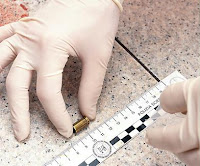
· A documentation of the scene using photographs,videos, sketches, plans and written notes of the aspect of the scene as it was found.
· So that no detail is left unnoted the investigators search the isolated area in a spiral, box or linear fashion.
· Lastly the evidnece is numbered with a flag, jointly with a metric measurement and photographed.
Upon completing the screening, each piece of evidence is carefully collected, packaged, labeled and sent to the laboratory for an examination in depth. Hair, fiber, and body fluids that contain genetic material and volatile liquids ,being more fragile, therefore has priority. It is very important that the containers in which these are transported be completely identified with data such as date, time, the name of the victim, the location of the evidence, the type, number, the name of the person who collectd it and court case to which they belong. It is also essential that all the professionals involved or collaborated in the collection of evidence are recorded, in case any problems arise from cross contamination.

Translated by Teresa Felgueiras
Saturday, December 8, 2007
Results of the pool
| The second question was: What is the first step that the person responsible by criminal law in field must take when he/she arrives at the crime scene? The answers were: collect clues - 11 votes take phtots - 12 votes collect the body - 11 votes isolate the area - 26 votes The correct answer is isolate the area, that was the most voted by our visitors. This is one of the techniques used by specialists to make a very important exam - eye inspection. Do not miss the news about the procedures of criminal law in field. |
Saturday, December 1, 2007
Criminal law field

- Biological - from biological traces which are found on the victim of a crime or on the crime scene, is compared with the genetic profile of the person.
- Non biological - is the analysis of digital printing, palms and feet. These tests can be carried out in the laboratory of scientific expertise of the Judicial Police.
Individuals who work in this area are called criminalists. These experts are the first to reach the scene, of the crime, they see what others don't see, catch the culprits, dominate the use of laser and ultiviolet rays, wear appeling uniforms and have at their disposal the most advenced technology.
Their work begins, as it can only be expected, at the crime scene.